

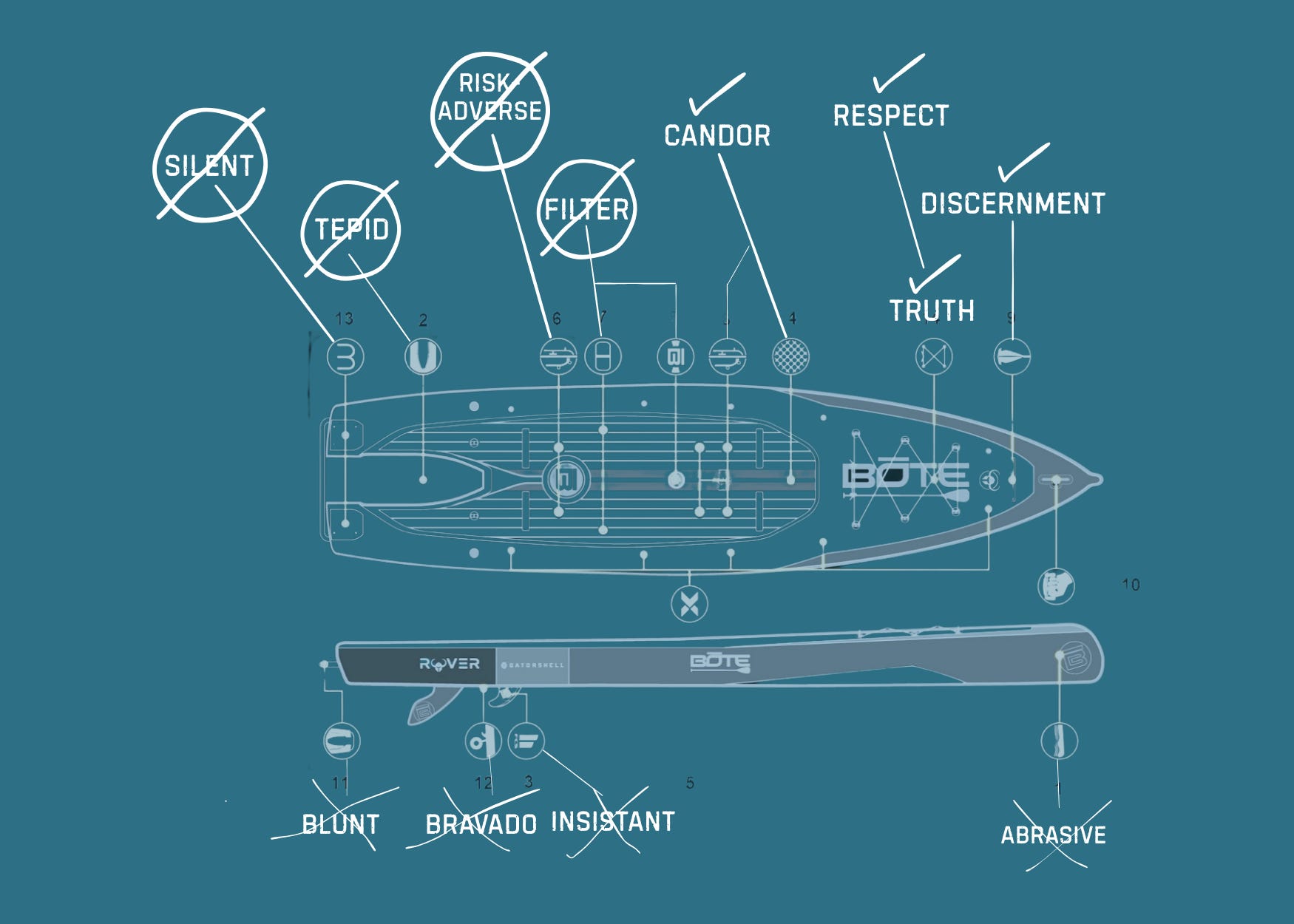
If you’ve ever observed a beginner on a paddleboard, there’s a tepidness in movement that’s hard to watch. The beginner most often looks like he’s trying not to do something rather than trying to actually do something — crouched down, knees bent, unsteady and unsure. It’s a strain. Just fall in already.
Except they don’t. The beginner paddles carefully, with noodle arms that don’t slice the water. So the paddleboarder avoids the fall. But what good is that? Success, in this case, is defined by staying on the board, dry and useless, making an unproductive turn at covering very little distance.
This assessment is harsh, perhaps, but it’s meant to celebrate the opposite approach: Fall in, get wet, put it all out there, resolute and self-assured.
You might recognize a version of the paddleboarder’s careful tepidness in the workplace. Restraint in how we communicate is often misunderstood as professionalism or deference. Anyone familiar with blue-collar work and workplace culture a generation or two ago has seen the opposite of professional restraint: a good cussing, wrenches thrown, checks docked and people fired and rehired on a regular basis. This approach was chaotic and unproductive, but in many workplace environments today, we seem to have overcorrected.
A lack of candor can lead to unproductive conversations and ill-informed decision making. Too often, our office demeanor is one of two things: 1) careful and tepid; or 2) abrasive and cynical.
There is, in fact, another way. It’s the art of packaging the sharp edges of candor in the bubble wrap of respect.
Hedging Leads to Uninformed Decision-Making
It’s worth slowing down here and being precise about what’s actually happening. These “careful” behaviors are not random, and they aren’t the result of individual incompetence or lack of courage.
What’s Next
i3 Family Ecosystem: Independent Pieces Become a Thriving Collective
We’ve recently updated our i3 website and, in doing so, we’ve shared some thoughts on our family ecosystem, and how it works to mitigate the challenges families in business face. We like the word “ecosystem” because it's designed to do the one thing families in business need above all else: Take independent entities and informational resources and harmonize each into a single, thriving collective. We’ve also provided a simple sketch to illustrate how it all comes together. Read It →
Where Have All the Assets Gone?
After working with families in business for decades, we’ve learned that many family enterprises accumulate “filing cabinet assets.” And, often, these assets are now worth a lot of money. Much of what we do as a firm is built around this first step: Uncovering the history and operating details of an enterprise by collecting, organizing, presenting and analyzing every document and item in that proverbial filing cabinet. It’s a family’s library of information; it’s the piece that makes our ecosystem go. Read It →
When Estate Docs Can’t Answer Your Questions
In this post, we explore the gap between when estate documents are drafted and when litigation sometimes ensues. Who exists in the middle, and who does the work to prevent litigation from happening at all? We know the paperwork often leaves questions unanswered, but we encourage families to avoid leaving questions unasked. There are answers to be had. But first, what’s the difference between mechanical questions and emotional questions, and does it matter? Read It →

The Big Read by Family Matter
About Family Matter and i3
”Family Matter“ is a content series by Kevin Heaton, founder and principal of i3 Global Enterprises, a private asset management and family CFO office. Newsletters and emails like “The Big Read” feature the latest content from Kevin and select posts from i3resources.com, our company’s website.
i3 helps families in business navigate the unique financial challenges and interpersonal conflicts that threaten long-term wealth preservation and growth. Our families reach positive outcomes through nuanced i3 processes and operational systems that align four core pillars: succession planning and family governance, wealth analysis and reporting, financial infrastructure and forecasting and private asset management (if needed). By creating durable systems within a financial ecosystem that’s tailored to each family’s needs, i3 Global helps families in business foster financial and relational harmony and grow wealth over generations. To learn more about i3 Global Enterprises, visit i3resources.com. Or contact us here.